The Moon Today
- Moon phase: first quarter
- Illumination: 53 %
- Distance to earth: 251 171 miles
- Next full moon: 7 days
Live moon image
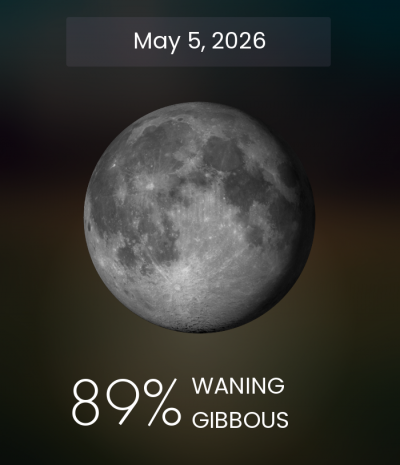
Use this image:
This image is automatically updated every day. You can use it on your website, your blog and your various projects (for example in home automation).
Just copy/paste the code below. It is possible to customize the image by clicking on the "Customize" tab. The code to copy-paste updates according to the modifications.
Connect to this page with a computer screen to customize the image and retrieve the code to copy-paste.
The moon for the next days
|
sundaySun. September 20
|
|
first quarter 62 % | ||
|
mondayMon. September 21
|
|
waxing gibbous 71 % | ||
|
tuesdayTue. September 22
|
|
waxing gibbous 80 % | ||
|
wednesdayWed. September 23
|
|
waxing gibbous 87 % | ||
|
thursdayThu. September 24
|
|
waxing gibbous 93 % | ||
|
fridayFri. September 25
|
|
waxing gibbous 97 % | ||
|
saturdaySat. September 26
|
|
full moon 100 % | ||
|
sundaySun. September 27
|
|
waning gibbous 99 % | ||
|
mondayMon. September 28
|
|
waning gibbous 97 % | ||
|
tuesdayTue. September 29
|
|
waning gibbous 92 % | ||
|
wednesdayWed. September 30
|
|
waning gibbous 85 % |
About the moon
Summary
How to know if the moon is waxing or waning?
To determine whether the moon is waxing or waning, you must observe the apparent shape of the illuminated part of the moon.
- 🌓 When the illuminated part is on the right side of the moon, it indicates a waxing phase.
- 🌗 Conversely, if the left side is illuminated, then it is the waning phase.
The method therefore consists of observing the side of the illuminated part to determine whether it is in the waxing or waning phase.
What are the different phases of the moon?
The moon goes through different phases throughout its 29.5-day cycle, resulting from the interaction between the Earth, the moon and the sun. Here are the main lunar phases:
- 🌑 New moon: The moon is located between the Earth and the sun, and the illuminated face is not visible from Earth.
- 🌒 Waxing crescent: A thin portion of the moon becomes visible, forming an illuminated crescent.
- 🌓 First quarter: The right half of the moon is illuminated.
- 🌔 Waxing gibbous: Three quarters of the moon are illuminated.
- 🌕 Full moon: The visible face of the moon is fully illuminated, as it is directly opposite the sun from Earth.
- 🌖 Waning gibbous: Three quarters of the moon are illuminated, but this time on the left side.
- 🌗 Last quarter: The left half of the moon is illuminated.
- 🌘 Waning crescent: A thin portion of the moon becomes visible, forming an illuminated crescent on the left side.
The cycle begins again with a new moon. These lunar phases result from the relative change in position of the moon with respect to the Earth and the sun.
What is the illumination of the moon?
The illumination of the moon represents the portion of the visible surface of the moon that is illuminated by the sun. It is measured as a percentage, where 0% illumination indicates a new moon (completely in shadow), and 100% illumination corresponds to a full moon (fully illuminated).
Throughout the lunar cycle, the illumination of the moon varies. The waxing phases show an increase in illumination up to 100% at the full moon. Then, the waning phases show a decrease in illumination down to 0% at the new moon.
The different intermediate phases display varying percentages of illumination, thus offering visual diversity throughout the lunar month. This measurement is often used to describe the apparent brightness of the moon at any given time.
Why do we always observe the same face of the Moon from Earth?
We only see one side of the Moon from Earth due to a phenomenon called "gravitational locking" or "synchronous rotation." This means that the Moon rotates on its axis in about the same time it takes to orbit the Earth. As a result, one side of the Moon (the side visible from Earth) is always facing our planet.
Gravitational locking results from the interaction between the gravitational forces of the Earth and the Moon. Over time, the tidal forces caused by the Earth have slowed the Moon's rotation, eventually bringing the same face to always face the Earth.
However, it is important to note that although we only see one side of the Moon from Earth, this does not mean that the opposite side, often called the "dark side," is always in darkness. Space missions, such as those from NASA, have mapped and explored this non-visible side, revealing that it is just as illuminated as the visible side, but is simply always facing away from us.